
Rotterdam — Poetry International returned to the city last weekend, bringing poets from across the globe to Theater Zuidplein, LantarenVenster and Belvédère. Despite its international reputation, this year’s edition was marked by chaotic programming, unclear artistic choices and a striking lack of respect toward the press.
1034 words – 5 minutes
A Turbulent Opening at Theater Zuidplein
The festival opened on Thursday, 4 June, at Theater Zuidplein with a program that felt more like a competition for attention than a curated literary event. Poets read in their own languages. The reading got interrupted by short drum intermezzos or performances by members of Koor op Zuid. Koor op Zuid is a chorus of people living in Rotterdam South. Singing quality is not required. The only requirement to join the chorus is that you live on South. The result was a fragmented evening in which neither the poetry nor the performers were given space to breathe. After this opening night, the festival abandoned Zuidplein entirely and moved to the Kop van Zuid for readings at LantarenVenster and workshops at Belvédère.
A Dense and Disconnected Program
On Friday, Poetry International scheduled fourteen events between 18:30 and 23:00 at LantarenVenster, ending with The Last Poem. Saturday it started at 12:30 and untill The Last Poem at 23:00 they had scheduled 30 readings, workshops and a poetry cycle. Sunday started one hour earlier, with workshops at Belvédère and readings at LantarenVenster till the final reading the Last Poem at 19.15. Between 17.00 and 19.00 I went to the talkshow De Kronieken in the Unie and when I went back to Poetry everyone was gone already.
The program grid’s painfully showed the disconnection. It was not about the poets. They were mostly not mentioned in the brochures. Mostly it only stated venue, time, event and its host. Most events lasted no more than 45 minutes, and by the time everyone had taken their seats and the poet(s) had been introduced, the show was already over.. The densit program of short readings, 14 on Friday, 30 on Saturday and 24 on Sunday, combined with the constant venue changes, made it difficult for visitors to learn more about the poets and to dig in this year festival theme Word on the street.
Press Access: A Concerning Email
More troubling than the artistic confusion was the festival’s attitude toward the press. The Rotterdamse Persvereniging and our platforms Newsdam and Poetry On Air were dismissed in an internal email from the festival’s PR representative, Charlotte Huizink (Het PR Atelier). In the email, Huizink refers to one of our journalists as “a very dubious man,” states she does not know Poetry On Air, and suggests declining interviews due to “full schedules.” See below:
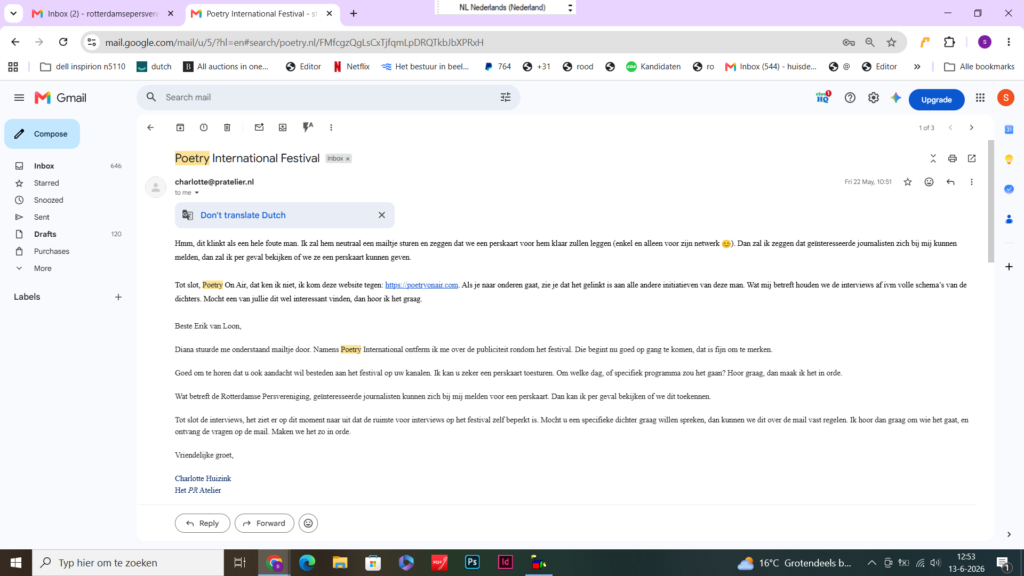
Dear Diana,
Hmm, this sounds like a very dubious man. I’ll send him a neutral email and say that we will have a press pass ready for him (solely and exclusively for his network 😊). Then I’ll add that any interested journalists can contact me directly, and I will decide on a case‑by‑case basis whether we can provide them with a press pass.
Finally, Poetry On Air — I don’t know it. I came across this website: https://poetryonair.com. If you scroll down, you’ll see it’s linked to all the other initiatives run by this man. As far as I’m concerned, we decline the interviews due to the poets’ full schedules. But if any of you are interested, please let me know.
Charlotte Huizink
Het PR Atelier
This raises questions about transparency, professionalism and equal access for local media. The communication choices made by Charlotte Huizink of Het PR Atelier and Diana Chin‑A‑Fat, Director of Poetry International, created unnecessary obstacles that made it significantly harder to write about my passion poetry and one of Rotterdam’s cultural highlights — a meeting place for poets, readers and international voices.
An Interview That Went Nowhere
I tried to pick up the promised presscard on Thursday. It was not ready. On Saturday I tried again. This time they refused to give me the presscard. Nevertheless I managed to speak briefly with the Indonesian poet and LGBTIQ activist Hendri Yullus Wijaya, who had spent several months in the Poetry International Writers’ Residence. The conversation was awkward. Wijaya declined to answer nearly every question.
On my first question with which LGBTIQ letter I should address Hendri. Hendri answered I am a poet. On my second question if he liked the Poetry International Writers in Residence Hendri answered: “I like the many opportunities in the Netherlands especially the open mics in cities like Nijmegen, Amsterdam, Utrecht and other cities. When I asked Hendri how about open mics in Indonesia. Hendri said “I am not aware of events like that in Indonesia as I just recently started to write poetry”. On my question if he had been published. Hendri said “only a few poems have been selected for some magazine. I don’t have a publication with my own poems yet”.
On questions about his activism, his religion and the influence of religion on his work. His replyid: I prefer to “talk about poetry,” though he refused to elaborate on his work.It was, by far, the least productive and most disrespectful interview given by a poet ever.
Through the rabbit hole
This year the festival also struggled with programming, poor communication and an unwelcoming attitude toward the press. The presentation of Nederlandse Gebarentaal (NGT) gestures on a single garbage truck in Rotterdam did little to improve matters. In the video below from Open Rotterdam, you can see the hand gestures that were chosen to translate in Dutch Sign Language to expressive a poem by Boaz Blume and Sam Onclin.
The question is why the organisation opted for stylised hand signs on a truck when presenting the poem itself — in written form — would have been far more accessible to the general public, including people who are deaf but not blind. The current approach felt symbolic rather than meaningful, and it raised further questions about the festival’s priorities.
Incidentally, ChatGPT does not recognise the sign language as official Dutch Sign Language (NGT) nor as International Sign. According to ChatGPT, it looks more like a collection of cartoon‑style hand gestures that strongly resemble Mickey Mouse’s iconic white gloves.